
Commercial Driver License: Requirements, Classes, and Training Guide

One would need a CDL to venture into the commercial driving sector. It licenses drivers to operate large or specialized vehicles, such as trucks, buses, and tankers, securely and lawfully on the highways. To get your CDL, which is also called a commercial driver’s license, you must follow certain requirements of the CDL, such as age limitations, medical restrictions, and passing the written and driving tests designed to suit commercial vehicles.
As a future driver, in order to get your CDL, you should know the kinds of CDLs that are offered, the training procedures required, and the process of applying for the license. This is a complete guide that will help you know all you need to know to apply for the CDL and begin your career as a commercial driver.
The business-to-consumer transport sector is also expanding, which has generated many job opportunities for skilled drivers in the different sectors. Large-scale freight delivery services as well as small-scale local deliveries are in need of competent commercial drivers. The licensing process can be made easier by learning all about it, and this way, you can make this career easier and place yourself in the competitive commercial driving market.
To the fleet owners and managers, this scarcity underscores why developing an in-house driver pipeline by licensing CDLs is not only a compliance measure but also a strategic decision that would save them money in recruiting drivers and ensure that they do not have to depend on the external labor market to keep the trucks on the road.
CDL Overview
A commercial driver’s license or CDL is a legal authorization that gives commercial motor vehicle (CMV) drivers permission to drive large trucks, buses, and hazardous material carriers. CDL requirements for drivers are based on the size of the vehicle and the type of cargo that they are going to deal with.
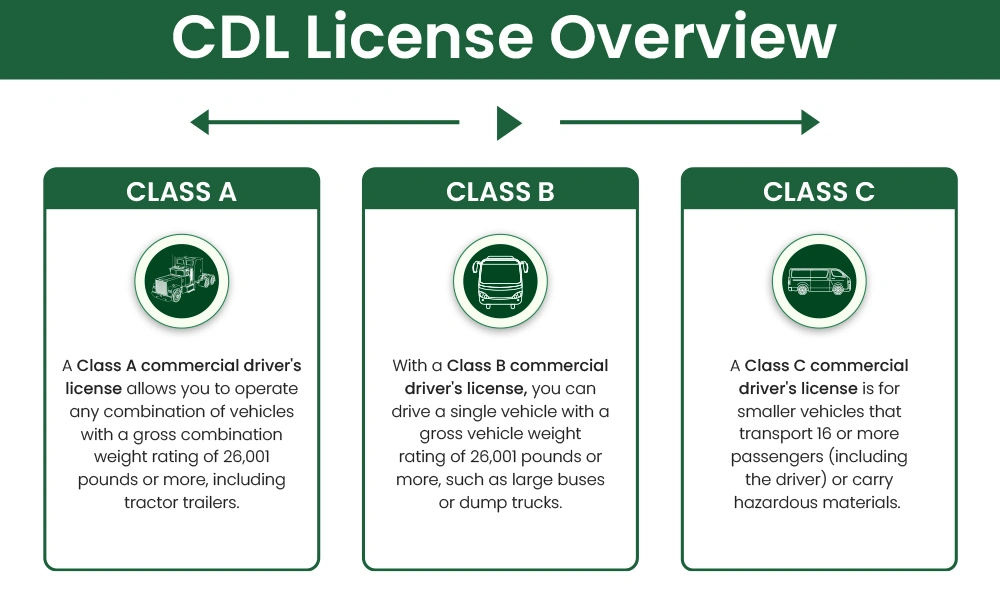
The three CDL classes include Class A, Class B, and Class C. Each CDL class has its specific regulations and range of operations. It is very important to know the differences and the demands of each class before applying. To achieve the CDL requirements, one has to take written knowledge tests and practical evaluation of driving skills, and ensure that the drivers are competent and safety-conscious. Read more on Class A CDL inspection procedures, which professional drivers have to master.
The Federal Motor Carrier Safety Administration (FMCSA) has set the standards of commercial driver licensing in all states so that the requirements of training and testing are consistent. This federal control assists in the safety level and gives states an opportunity to make certain rules that will respond to the local circumstances and demands.
The field of commercial driving is very broad in terms of the number of types of vehicles and the situations of their operation. To select the right type of CDL or CDL class that can best fit your career objectives, it is very important to consider the kind of vehicles you are going to operate, the distance you are willing to cover, and the endorsements that can make you more employable in the commercial transportation industry.
The licensing process will be such that commercial drivers have the knowledge, skills, and physical abilities to use large vehicles safely. This also involves knowledge in complex traffic regulations, maintenance regulations, hours of service regulations, and emergency procedures, which are unique to the operation of commercial vehicles.
Class A CDL vs. Class B CDL
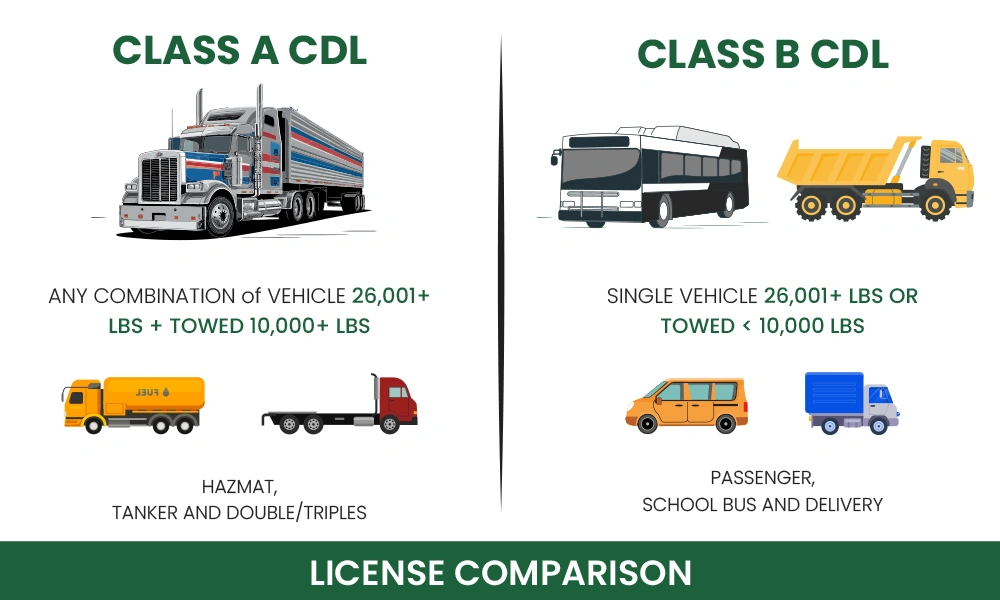
Class A CDL allows one to drive vehicles that have a gross combination weight rating (GCWR) of 26,001 pounds and above, provided the towed vehicle weighs over 10,000 pounds. This license is required for operating tractor-trailers and tanker trucks carrying large loads. When paired with the proper endorsements, a Class A CDL provides the greatest scope of operation in commercial driving.
Conversely, the Class B CDL permits drivers to drive a single vehicle with a gross vehicle weight rating (GVWR) of 26,001 pounds or higher, or pulling a vehicle, the weight of which is 10,000 pounds or less. A Class B CDL is required to drive heavy straight trucks, buses, and certain dump trucks.
The requirements of the training and the components of the exams are specific to each class of license. The one that you take is dependent on your career objectives. To drivers who are moving between various operational needs, knowledge of how to change a CDL from intrastate to interstate can be useful in increasing career opportunities.
The Class B CDL is commonly used in conjunction with urban operations (such as buses or dump trucks), whereas the Class A CDL offers flexibility for long-haul and heavy-freight. The selection of the appropriate type of license among your driver pool may maximize the use of your fleet and reduce downtimes.
Commercial Learner’s Permit and CDL Permit Requirements
You will need to obtain a commercial learner’s permit (CLP) before you are given your CDL. CDL permit requirements permit you to practice driving under supervision. The commercial learner’s permit application requires taking some knowledge tests of general commercial driving rules, endorsements of particular types, and types of vehicles.
The CDL permit requirements also involve demonstration of age, medical certification, and valid identification. It must also take a minimum duration to hold a commercial learner’s permit, which is usually 14 days before you can take the CDL skills test, and one of the important aspects of CDL permit requirements.
“A Midwest fleet manager explained that covering CLP costs for new recruits cut turnover by 40% in the first year, as drivers felt invested and stayed loyal.”
Future commercial drivers are expected to realize that they must be properly documented and compliant. Commercial drivers: Multi-drivers Fleet operators can gain insight into what an ELD system is and its implications on the commercial driving operation.
In the case of fleets, the cost of CLPs of recruits is a good retention strategy. Drivers that are trained and licensed under company sponsorship are more likely to remain loyal, reducing turnover and saving your investment.
Steps to Apply for a CDL
The process of getting CDL is a formal one that begins with the establishment of the fact that you are in compliance with all the requirements of the CDL, such as being 18 years old (or 21 years old in the case of interstate driving) and being medically fit to drive heavy vehicles.
The second step is to apply for the commercial learner permit by taking the required written exams at your state DMV. Drive with your permit under supervision to develop skills before the final skills test.
Lastly, complete and pass the practical driving examination, which is a test that determines your capability to check vehicles, operate the truck or the bus, and drive safely on the roads. Once you pass, you are given your full commercial driver’s license.
The application process will start with the collection of the necessary documentation that usually consists of evidence of identity, Social Security number, legal presence in the United States, and state of residence. Other states have other requirements or expedited processing of some applicants.
The CDL application process includes background checks as a regular part. This involves checking your driving history of violations, accidents, or license suspension that could make you ineligible to drive commercially. Knowing what is considered a disqualifying offense may assist the applicants in resolving the problems at an early stage, or know when they should wait before they can apply.
The written knowledge tests are state-specific, but usually include federal regulations, vehicle operation principles, safety procedures, and areas of endorsement. Computerized testing with immediate results is provided in many states, and in others, it may require scheduled appointments or provide paper-based alternatives.
It is also important to prepare finances before getting CDL, because CDL licensing has several fees, such as permit applications, testing fees, the cost of license issuance, and even the cost of the training program. Knowing the total cost in advance will enable the applicants to plan their budget and prevent wastage of time because of a lack of funds.
The scheduling process of the skills test may take a lot of time, depending on the location, with some areas having a longer wait than others. The licensing process can be hastened by planning in advance and being flexible with testing dates and locations, which will get you on the road sooner.
Getting a CDL depends very much on the skills test, practice, and preparation between obtaining the permit and taking the test. This is not just driving practice but also learning how to inspect the vehicle prior to the trip, learning about the vehicle systems, and gaining the confidence to act in the conditions of examination. Knowledge of truck preventive maintenance is useful in making sure that vehicles are in good condition and that they are roadworthy.
On the fleet level, this process can be streamlined with the help of HR and compliance teams to minimize the delays during onboarding. A large number of carriers incorporate CDL application support into driver recruitment as a way of accelerating time-to-road and minimizing expensive downtime.
CDL Training Requirements
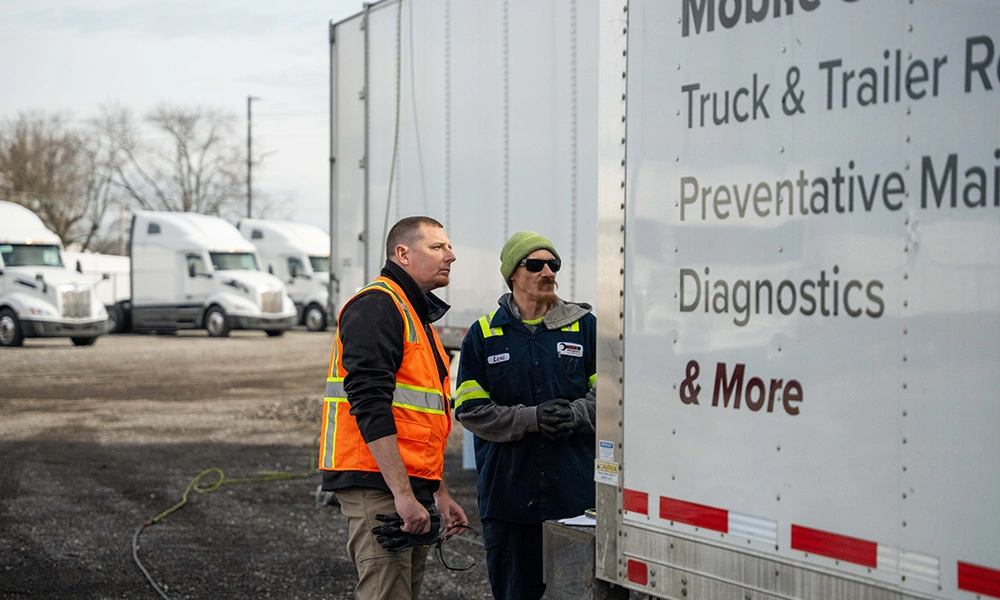
The knowledge and skills required to operate commercial vehicles safely can only be developed by complying with CDL training requirements. CDL training requirements for the majority of states have set a prerequisite of having a certified CDL training program before the CDL exam.
Training programs will normally incorporate classroom training on safety rules, vehicle inspection, transport laws, and on-the-job training on driving using commercial trucks or buses. The successful completion of a full-course CDL training can be used to guarantee the preparation to take the written and practical exams.
Proper preparation, such as knowledge of fleet safety procedures, is important to career-oriented drivers as well as for CDL training requirements. Get acquainted with the preparation for commercial fleet inspections to guarantee the lack of violations.
In the case of fleets, ROI is even greater: According to the National Transportation Institute, carriers save $15,000+ per driver in lower recruiting expenses when they invest in training their own employees rather than hiring new ones. Training also makes sure that drivers are conversant with your fleet TMS, ELDs, and safety systems on the first day.
“A Southeast trucking company found that in-house CDL training not only reduced recruiting costs but also improved safety scores by 18% within a year, thanks to drivers being trained on the fleet’s own safety systems from day one.”
Getting a CDL for Truck Driving
The CDL is the key to a professional truck driving career. It is required to muster the physical, mental, and educational requirements, obtain a commercial learner permit, undergo mandatory training, and pass licensing exams.
The careers in truck driving include short-haul deliveries and long-haul freight transportation, and endorsements in tanker driving and hazardous materials transportation can be made to enhance employability.
Professional drivers are expected to be aware of the industry environment, such as fleet management trends that influence career prospects and operational demands in the trucking sector.
For owner-operators that grow to small fleets, getting CDL training sponsored for drivers is not a compliance requirement, but it can be a powerful competitive advantage, as it strengthens your hiring pipeline and reduces the risk of trucks sitting idle due to labor shortages.
Tips for Earning Your CDL
To obtain your CDL, you need to be disciplined, prepared, and dedicated. Begin by reading the CDL manual of your state and doing plenty of practice exams. Taking certified CDL training programs assists in the process of translating theoretical knowledge into practical competence.
Physical fitness and medical certification are crucial to passing the federal Department of Transportation requirements. Having a clean driving record and good time management skills can also help you get licensed.
Knowledge of fleet operations can be a good career lesson. Get to know why fleet management is important and its effects on professional drivers in the commercial transportation sector.
Fleet wise, promoting preventive maintenance and safety practices among CDL candidates would bring them into the same thinking as the actual fleet operation, and minimize the risk once they are in the cab.
Conclusion
The CDL exposes a wide range of opportunities in commercial driving, but one needs to know the types of licenses, application procedures, and training needs. Formal training, study, and practice are important to success. To have a full fleet support service that ensures that the commercial vehicles are on the road and are in compliance with the rules, look at Epika Fleet Services and their professional mobile fleet maintenance services.
Frequently Asked Questions
Can I drive a pickup truck with a CDL?
Yes, a CDL can be used to operate a pickup truck that typically falls under a standard Class C license. However, a CDL is only required when the vehicle is used commercially, exceeds regulated weight limits, or transports hazardous materials that require proper endorsements.
What is the frequency of renewal of a truck CDL?
The renewal of a CDL is typically done every four to eight years, according to the state, and some endorsements may need to be renewed more frequently. Medical certifications normally have to be renewed every two years.
Do you have any age limit to obtain a truck CDL?
Yes, the minimum age requirement is 18 years old in intrastate commercial driving and 21 years old in interstate commercial driving. There are more age requirements in some endorsements.
Can I transfer my CDL if I move to another state?
Yes, you may transfer your CDL to another state; however, you have to apply to the new state within 30 days of establishing residence. The new state will check your driving history and might have to conduct further examination.
What is the disqualifying factor of a CDL?
Some criminal convictions, serious traffic offenses, failed drug tests, medical conditions that affect driving capacity, and numerous suspensions of the license are some of the disqualifying factors. Certain disqualifications are state-dependent and may be either temporary or permanent.
What is the price of obtaining a CDL?
Prices depend on the state and the training method, but generally, the prices of the training programs are between 3000 and 7000 dollars in the case of private training programs. This covers the cost of training, the cost of testing, medical examination, and the cost of licensing. Programs sponsored by the company can minimize initial expenditure.